
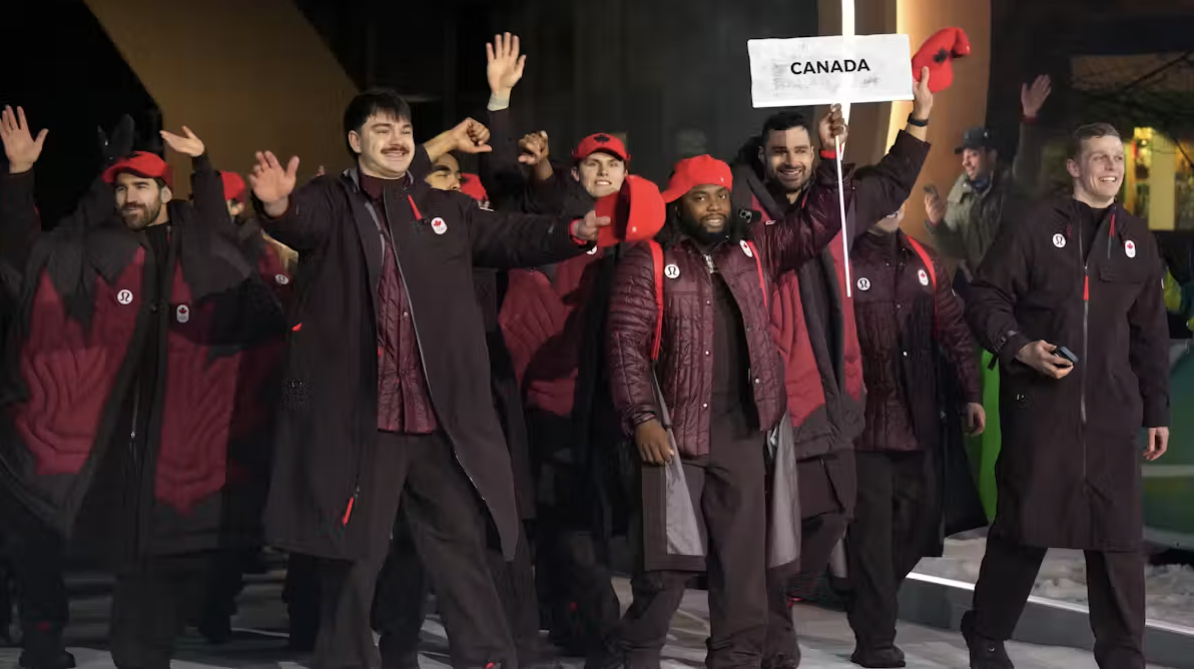
Team Canada arrives for the Olympic opening ceremony at the 2026 Winter Olympics, in Cortina d'Ampezzo, Italy, on Feb. 6, 2026. (AP Photo/Misper Apawu)
Written by: Taylor McKee, Janelle Joseph, and Lucas Rotondo
Article published in The Conversation
As the 2020 Tokyo Olympics approached, fans around the world struggled to balance their excitement with a general uneasiness surrounding the Games. These included high-profile firings, volunteers quitting, abnormally high temperatures, low vaccination rates as well as a declared state of emergency amidst surging COVID-19 cases.
While there were many engaging story lines and developments worth following over the last 14 days, the prominence of Black women was hard to ignore.
From the outset of the Games’ opening ceremony, where Naomi Osaka lit the Olympic cauldron, it quickly became evident that Black women would be of central importance to the games and stories that followed.
Forging a nation through sport
One of the earliest Canadian sports stories ever told was explicitly about forging something new under the weight of empire. In 1867, days after Confederation, a working-class crew from Saint John, New Brunswick, competed in rowing at the Paris Exhibition, a world’s fair held in France.
The “Paris Crew” quickly became a national symbol, not just because they won, but because the victory felt like a young country holding its own against an older imperial world. It became a story of Canadians carving out space on an international stage that was not designed with them in mind.
Over time, what it meant to see Canada represented in sport started to change. By the early 2000s, a familiar insecurity lingered.
This sentiment did not survive Canada’s exceptional performance at Vancouver 2010 when the country won a historic 14 gold medals.
In the lead-up to those Olympics, the federal government invested heavily in a high-performance system built to deliver medals. Even the name of the initiative — Own the Podium — put it plainly. Excellence was no longer a wish for Canada, but the standard, and the resources followed.
When sovereignty feels unsettled again
Today, the ground feels less stable again. Canada’s relationship with its closest ally, the United States, is under intense strain due to ongoing tariff disputes and repeated threats to Canadian sovereignty from the American president.
Canadians are testing their mettle by discerning whether they have the skills and endurance to publicly defend and perform sovereignty on the national stage.
Sport is an ideal forum for this because it’s already built as a competition among national units, even when lived reality is far more regional and local.
This renewed attention to sovereignty can feel like a throwback to the Paris Crew moment, when defeating bigger powers looked like a form of self-determination.
Dual narratives
The effort to balance the complexities of national pride and sovereignty under a colonial shadow takes on even more complexity through the participation of Indigenous athletes.
Following Alwyn Morris and Hugh Fisher’s 1000-metre sprint kayak gold medal at the 1984 Summer Olympics, Morris gave an eagle feather salute to his grandfather. This moment is widely remembered as a positive example of Indigenous resurgence through sport, and a reclaiming of cultural space.
At the same time, as Morris himself has explained, the gesture was a reminder that Indigenous identity does not dissolve into “Team Canada,” even during moments many Canadians want to read as uncomplicated unity.
That is why Morris’s salute still matters. It shows how representation can hold two truths at once. Morris was awarded gold while wearing red and white, but he claimed his win as one for “the other part of who [he] is,” showing how Indigenous sport stories cannot be reduced to a single national storyline.
Indigenous resistance through sport
Perhaps the longest-running example of Indigenous resistance through sport is the Haudenosaunee Nationals lacrosse team, which competes internationally as a sovereign nation.
Contemporary lacrosse reflects a version of the sport that is much different than what Haudenosaunee People have traditionally revered as a “medicine game.” In the late 1800s, when “The Creator’s Game” was colonized and rebranded as “Canada’s National Game,” Indigenous peoples were barred from competition.
Today, the Haudenosaunee Nationals are the only sports organization in the world to compete in international competitions while representing an Indigenous confederacy as a sovereign nation.
Representing the Haudenosaunee, the Nationals embody Indigenous reclamation and resurgence. With lacrosse returning to the 2028 Summer Olympics, the Haudenosaunee’s claim for sovereignty is once again on the line.
Canada’s national story
For most Canadians, international sport is the easiest place to feel the nation in real time. A flag goes up. An anthem plays. A medal table is refreshed. In a few minutes of speed, grace and accuracy, complicated questions about history, economy and belonging collapse into a simple narrative.
Through these articulations of Indigenous sovereignty, representation and resurgence, Indigenous athletes have reminded “Team Canada” why this narrative isn’t as simple as it feels. For Indigenous Canadian athletes, participation is about representing the communities that came together to believe in them.
It’s about celebrating family strength, healing inter-generational trauma and leading a new path. It’s about resisting threats to sovereignty and reclaiming what was taken away.
That is exactly why sport becomes so charged when Canadians feel our sovereignty is under pressure, whether that pressure is literal, symbolic or both. In sport, athletes are asked to do more than win medals — they are asked to stand in for Canada itself and to reassure audiences that the country is coherent, respected and capable of protecting what is considered ours.